Wall Art Made in Aurora Co by Melting Bottles Togather

Glass jars on shipping pallets


A modern "French Kilner" jar
Glass production involves two primary methods – the float glass process that produces canvass glass, and glassblowing that produces bottles and other containers. It has been done in a diverseness of ways during the history of glass.
Glass container product [edit]
Broadly, modern glass container factories are three-part operations: the batch house , the hot stop , and the common cold cease . The batch house handles the raw materials; the hot end handles the manufacture proper—the forehearth, forming machines, and annealing ovens; and the cold end handles the product-inspection and packaging equipment.
Batch processing organization (batch house) [edit]
Batch processing is one of the initial steps of the glass-making procedure. The batch house only houses the raw materials in large silos (fed past truck or railcar) and holds anywhere from one–5 days of material. Some batch systems include material processing such as raw material screening/sieve, drying, or pre-heating (i.e. cullet). Whether automatic or manual, the batch house measures, assembles, mixes, and delivers the drinking glass raw fabric recipe (batch) via an array of chutes, conveyors, and scales to the furnace. The batch enters the furnace at the 'dog house' or 'batch charger'. Dissimilar glass types, colors, desired quality, raw textile purity / availability, and furnace design volition bear on the batch recipe.
Hot end [edit]
The hot stop of a glassworks is where the molten glass is manufactured into glass products. The batch enters the furnace, then passes to the forming process, internal handling, and annealing.
The following tabular array lists common viscosity fixpoints, applicable to large-scale glass production and experimental glass melting in the laboratory:[i]
| log10(η, Pa·s) | log10(η, P) | Description |
|---|---|---|
| 1 | two | Melting point (glass melt homogenization and fining) |
| 3 | 4 | Working betoken (pressing, blowing, gob forming) |
| 4 | 5 | Menses point |
| half-dozen.6 | seven.6 | Littleton Softening betoken (drinking glass deforms visibly under its own weight. Standard procedures ASTM C338, ISO 7884-iii) |
| 8–x | ix–xi | Dilatometric softening Point, Td, depending on load[2] |
| x.5 | 11.five | Deformation point (Glass deforms under its ain weight on the μm-scale inside a few hours.) |
| 11–12.3 | 12–13.3 | Drinking glass transition temperature, T1000 |
| 12 | xiii | Annealing point (Stress is relieved within several minutes.) |
| thirteen.5 | xiv.5 | Strain point (Stress is relieved within several hours.) |
Furnace [edit]

Batch feed doghouse of a drinking glass furnace
The batch is fed into the furnace at a slow, controlled rate past the batch processing arrangement. The furnaces are natural gas- or fuel oil-fired, and operate at temperatures up to 1,575 °C (2,867 °F).[3] The temperature is limited but by the quality of the furnace's superstructure material and by the glass composition. Types of furnaces used in container glass making include end-port (end-fired), side-port, and oxy-fuel. Typically, furnace size is classified past metric tons per day (MTPD) production capability.
Forming process [edit]
There are currently ii principal methods of making glass containers: the blow and blow method for narrow-neck containers but, and the press and blow method used for jars and tapered narrow-neck containers.
In both methods, a stream of molten glass at its plastic temperature (1,050–ane,200 °C [1,920–2,190 °F]) is cutting with a shearing blade to form a solid cylinder of drinking glass, chosen a gob. The gob is of predetermined weight just sufficient to brand a bottle. Both processes beginning with the gob falling, by gravity, and guided, through troughs and chutes, into the blank moulds, 2 halves of which are clamped close and then sealed by the baffle from above.

In the blow and blow process,[iv] the glass is first blown through a valve in the baffle, forcing it downward into the three-piece ring mould which is held in the neckring arm below the blanks, to form the finish. The term "end" describes the details (such every bit cap sealing surface, screw threads, retaining rib for a tamper-proof cap, etc.) at the open up end of the container. Then compressed air is blown through the drinking glass, which results in a hollow and partly formed container. Compressed air is and then blown over again at the second stage to give terminal shape.
Containers are made in two major stages. The first phase moulds all the details ("finish") around the opening, but the body of the container is initially fabricated much smaller than its final size. These partly manufactured containers are chosen parisons, and quite speedily, they are blow-molded into final shape.
The "rings" are sealed from beneath by a curt plunger. After the "settleblow" finishes, the plunger retracts slightly, to allow the skin that'due south formed to soften. "Counterblow" air then comes up through the plunger, to create the parison. The baffle rises and the blanks open. The parison is inverted in an arc to the "mould side" by the "neckring arm", which holds the parison by the "end".
As the neckring arm reaches the end of its arc, two mould halves close around the parison. The neckring arm opens slightly to release its grip on the "finish", so reverts to the blank side. Final blow, practical through the "blowhead", blows the glass out, expanding into the mould, to make the final container shape.
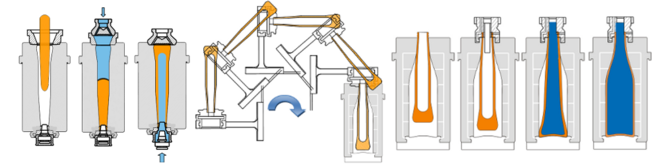
Steps during blow and blow container forming process
In the press and blow procedure,[4] the parison is formed by a long metal plunger which rises up and presses the glass out, in lodge to fill the ring and blank moulds.[5] The procedure and then continues as before, with the parison beingness transferred to the last-shape mould, and the glass being diddled out into the mould.
The container is and so picked up from the mould by the "accept-out" mechanism, and held over the "deadplate", where air cooling helps cool down the still-soft glass. Finally, the bottles are swept onto a conveyor by the "push out paddles" that have air pockets to proceed the bottles standing after landing on the "deadplate"; they're now ready for annealing.
Forming machines [edit]

IS automobile during bottle production.
The forming machines hold and move the parts that class the container. The machine consists of xix basic mechanisms in operation to form a bottle and by and large powered by compressed air (high pressure – 3.2 bar and low pressure – 2.8 bar), the mechanisms are electronically timed to coordinate all movements of the mechanisms. The most widely used forming machine system is the individual section machine (or IS machine). This car has a bank of v–20 identical sections, each of which contains one complete set of mechanisms to brand containers. The sections are in a row, and the gobs feed into each section via a moving chute, called the gob distributor. Sections make either one, two, 3 or four containers simultaneously (referred to as single, double, triple and quad gob). In the case of multiple gobs, the shears cut the gobs simultaneously, and they fall into the blank moulds in parallel.
Forming machines are largely powered past compressed air and a typical glass works will take several big compressors (totaling 30k–60k cfm) to provide the necessary compressed air. Withal in recent times servo drives have been implemented in the machines which achieve a better digital control of the forming procedure. It is one pace to initialize industries two.0 in this co-operative. Furnaces, compressors, and forming machines generate large quantities of waste heat which are more often than not cooled past water. Hot glass which is non used in the forming machine is diverted and this diverted glass (called cullet) is generally cooled by h2o, and sometimes even processed and crushed in a h2o bath system. Ofttimes cooling requirements are shared over banks of cooling towers arranged to allow for backup during maintenance.
Internal treatment [edit]
After the forming procedure, some containers—particularly those intended for alcoholic spirits—undergo a treatment to improve the chemical resistance of the inside, called internal treatment or dealkalization. This is usually accomplished through the injection of a sulfur- or fluorine-containing gas mixture into bottles at high temperatures. The gas is typically delivered to the container either in the air used in the forming process (that is, during the last blow of the container), or through a nozzle directing a stream of the gas into the rima oris of the bottle afterwards forming. The treatment renders the container more resistant to alkali extraction, which can cause increases in product pH, and in some cases container deposition.
Annealing [edit]
As drinking glass cools, it shrinks and solidifies. Uneven cooling may brand drinking glass more susceptible to fracture due to internal stresses: the surface cools first, then equally the interior cools and contracts it creates tension.[six] Even cooling is achieved by annealing. An annealing oven (known in the industry as a lehr) heats the container to about 580 °C (ane,076 °F), then cools it, depending on the glass thickness, over a xx – threescore infinitesimal menses.
Cold end [edit]
The office of the cold finish of drinking glass container product is to consummate the concluding tasks in the manufacturing procedure: spray on a polyethylene blanket for abrasion resistance and increased lubricity, inspect the containers for defects, label the containers, and parcel the containers for shipment.
Coatings [edit]
Drinking glass containers typically receive two surface coatings, ane at the hot end, just before annealing and one at the cold end just afterwards annealing. At the hot end a very thin layer of tin(IV) oxide is applied either using a safety organic compound or inorganic stannic chloride. Tin based systems are not the only ones used, although the almost popular. Titanium tetrachloride or organo titanates tin also exist used. In all cases the blanket renders the surface of the glass more adhesive to the common cold terminate coating. At the cold end a layer of typically, polyethylene wax, is applied via a h2o based emulsion. This makes the glass slippery, protecting it from scratching and stopping containers from sticking together when they are moved on a conveyor. The resultant invisible combined blanket gives a virtually unscratchable surface to the drinking glass. Due to reduction of in-service surface harm, the coatings frequently are described equally strengtheners, withal a more correct definition might be force-retaining coatings.
Inspection equipment [edit]
Drinking glass containers are 100% inspected; automatic machines, or sometimes persons, inspect every container for a variety of faults. Typical faults include small cracks in the drinking glass chosen checks and foreign inclusions chosen stones which are pieces of the refractory brick lining of the melting furnace that interruption off and autumn into the pool of molten glass, or more than unremarkably oversized silica granules (sand) that have failed to melt and which after are included in the final product. These are particularly important to select out due to the fact that they can impart a destructive chemical element to the final glass production. For example, since these materials can withstand large amounts of thermal energy, they can crusade the glass product to sustain thermal shock resulting in explosive devastation when heated. Other defects include bubbles in the glass called blisters and excessively sparse walls. Some other defect common in glass manufacturing is referred to every bit a tear. In the press and accident forming, if a plunger and mould are out of alignment, or heated to an incorrect temperature, the glass will stick to either item and get torn. In addition to rejecting faulty containers, inspection equipment gathers statistical data and relays it to the forming auto operators in the hot end. Computer systems collect mistake information and trace it to the mould that produced the container. This is washed by reading the mould number on the container, which is encoded (every bit a numeral, or a binary code of dots) on the container by the mould that fabricated it. Operators bear out a range of checks manually on samples of containers, usually visual and dimensional checks.
Secondary processing [edit]
Sometimes container factories will offer services such as labelling. Several labelling technologies are bachelor. Unique to drinking glass is the Practical Ceramic Labelling process (ACL). This is screen-printing of the decoration onto the container with a vitreous enamel paint, which is then baked on. An example of this is the original Coca-Cola bottle.
Packaging [edit]
Glass containers are packaged in various ways. Popular in Europe are majority pallets with betwixt 1000 and 4000 containers each. This is carried out by automatic machines (palletisers) which adjust and stack containers separated past layer sheets. Other possibilities include boxes and even paw-sewn sacks. Once packed, the new "stock units" are labelled, warehoused, and ultimately shipped.
Marketing [edit]
Drinking glass container manufacture in the developed world is a mature market business. Globe demand for flat glass was approximately 52 meg tonnes in 2009.[7] The United states of america, Europe and Communist china business relationship for 75% of demand, with Red china's consumption having increased from 20% in the early 1990s to 50%.[7] Glass container manufacture is also a geographical business; the production is heavy and large in volume, and the major raw materials (sand, soda ash and limestone) are by and large readily bachelor. Therefore production facilities demand to be located shut to their markets. A typical glass furnace holds hundreds of tonnes of molten glass, and so it is merely not practical to shut information technology down every night, or in fact in any flow curt of a month. Factories therefore run 24 hours a mean solar day 7 days a week. This means that there is lilliputian opportunity to either increase or decrease production rates by more than a few percent. New furnaces and forming machines cost tens of millions of dollars and require at least 18 months of planning. Given this fact, and the fact that there are usually more products than machine lines, products are sold from stock. The marketing/production challenge is therefore to predict demand both in the short four- to 12-week term and over the 24- to 48-month-long term. Factories are generally sized to service the requirements of a city; in developed countries there is usually a manufactory per 1–2 million people. A typical factory volition produce i–3 million containers a mean solar day. Despite its positioning equally a mature market product, glass does savor a high level of consumer acceptance and is perceived as a "premium" quality packaging format.
Lifecycle impact [edit]
Drinking glass containers are wholly recyclable and the glass industries in many countries accept a policy, sometimes required by authorities regulations, of maintaining a high cost on cullet to ensure loftier return rates. Return rates of 95% are not uncommon in the Nordic countries (Sweden, Norway, Denmark and Republic of finland). Return rates of less than 50% are usual in other countries.[ citation needed ] Of course glass containers tin can besides exist reused, and in developing countries this is common, however the environmental impact of washing containers as against remelting them is uncertain. Factors to consider here are the chemicals and fresh water used in the washing, and the fact that a single-use container can be made much lighter, using less than half the glass (and therefore free energy content) of a multiuse container. Also, a significant factor in the developed world'south consideration of reuse are producer concerns over the risk and consequential product liability of using a component (the reused container) of unknown and unqualified condom. How glass containers compare to other packaging types (plastic, cardboard, aluminium) is hard to say; conclusive lifecycle studies are nevertheless to be produced.
Bladder glass process [edit]
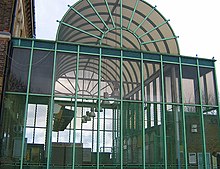
Float drinking glass is a sheet of drinking glass made by floating molten glass on a bed of molten metal, typically can, although lead and various low melting point alloys were used in the past. This method gives the sheet uniform thickness and very flat surfaces. Mod windows are fabricated from float glass. Most float glass is soda-lime glass, but relatively minor quantities of special borosilicate[8] and apartment console display drinking glass are as well produced using the float glass process.[nine] The bladder drinking glass process is also known equally the Pilkington process,[10] named after the British glass manufacturer Pilkington, who pioneered the technique (invented past Sir Alastair Pilkington) in the 1950s.
Environmental impacts [edit]
Local impacts [edit]
Equally with all highly concentrated industries, glassworks suffer from moderately high local ecology impacts. Compounding this is that considering they are mature market businesses, they often have been located on the same site for a long time and this has resulted in residential encroachment. The main impacts on residential housing and cities are noise, fresh water use, water pollution, NOx and SOx air pollution, and grit.
Noise is created by the forming machines. Operated by compressed air, they tin can produce noise levels of upwards to 106dBA. How this noise is carried into the local neighborhood depends heavily on the layout of the factory. Another cistron in dissonance production is truck movements. A typical factory will procedure 600 T of material a solar day. This ways that some 600 T of raw material has to come onto the site and the same off the site again equally finished production.
Water is used to cool the furnace, compressor and unused molten drinking glass. Water use in factories varies widely; it tin can be every bit little as one tonne h2o used per melted tonne of glass. Of the one tonne, roughly half is evaporated to provide cooling, the rest forms a wastewater stream.
Virtually factories utilise h2o containing an emulsified oil to cool and lubricate the gob cutting shear blades. This oil-laden water mixes with the water outflow stream, thus polluting it. Factories usually have some kind of water processing equipment that removes this emulsified oil to various degrees of effectiveness.
Nitrogen oxides are a natural production of the burning of gas in air and are produced in large quantities by gas-fired furnaces. Some factories in cities with item air pollution problems will mitigate this by using liquid oxygen, however the logic of this given the toll in carbon of (i) not using regenerators and (2) having to liquefy and transport oxygen is highly questionable. Sulfur oxides are produced as a consequence of the drinking glass melting procedure. Manipulating the batch formula can result some limited mitigation of this; alternatively frazzle plume scrubbing can be used.[half-dozen]
The raw materials for glass-making are all dusty textile and are delivered either as a pulverization or as a fine-grained fabric. Systems for decision-making dusty materials tend to be difficult to maintain, and given the big amounts of material moved each 24-hour interval, simply a minor amount has to escape for there to exist a dust problem. Cullet (broken or waste drinking glass) is likewise moved nearly in a glass factory and tends to produce fine drinking glass particles when shovelled or broken.
See also [edit]
- Mirrors
- Blow moulding
- Borosilicate glass
- Boston circular (canteen)
- Drinkware
- Float glass
- Glass disease
- History of glass
- Irving Wightman Colburn
- Packaging and labelling
- Wine canteen
- Cage loving cup
References [edit]
- ^ Werner Vogel: "Drinking glass Chemistry"; Springer-Verlag Berlin and Heidelberg GmbH & Co. K; 2d revised edition (November 1994), ISBN 3-540-57572-iii
- ^ The dilatometric softening indicate is not identical with the deformation point as sometimes presumed. For reference come across experimental data for Td and viscosity in: High temperature drinking glass cook belongings database for process modeling; Eds.: Thomas P. Seward III and Terese Vascott; The American Ceramic Society, Westerville, Ohio, 2005, ISBN ane-57498-225-7
- ^ B. H. Due west. S. de Jong, "Glass"; in "Ullmann's Encyclopedia of Industrial Chemistry"; 5th edition, vol. A12, VCH Publishers, Weinheim, Germany, 1989, ISBN iii-527-20112-2, pp. 365–432.
- ^ a b "The Blow and Blow Method". Eurotherm. Retrieved 2013-05-20 .
- ^ "Glass-Forming Motorcar". Farlex. Retrieved 2013-05-20 .
- ^ a b Varshneya, Arun (1994). Fundamentals of Inorganic Glasses. San Diego, CA: Harcourt Brace & Company. p. 518. ISBN0-12-714970-8.
- ^ a b zbindendesign
- ^ "Schott Borofloat". Archived from the original on 2009-05-05. Retrieved 2011-03-26 .
- ^ Not all flat panel display glass is produced past the float glass procedure. The company Corning is using the overflow downdraw technique, while Schott uses the float glass technique (see Schott website).
- ^ Benvenuto, Mark Anthony (2015-02-24). Industrial Chemistry: For Advanced Students. Walter de Gruyter GmbH & Co KG. ISBN9783110351705.
External links [edit]
chadwickanythincel.blogspot.com
Source: https://en.wikipedia.org/wiki/Glass_production
0 Response to "Wall Art Made in Aurora Co by Melting Bottles Togather"
Postar um comentário