Data Suggesting That Reduced School Funding Negatively Music and Arts in Schools
How Children Benefit from Music Education In Schools
Educational Benefits/Facts:
- Children who study music tend to accept larger vocabularies and more than advanced reading skills than their peers who practise not participate in music lessons (Arete Music Academy. "Statistical benefits of music in instruction." Arete Music Academy. Accessed July 17, 2014).
- Regardless of socioeconomic condition or school district, students (3rd graders) who participate in high-quality music programs score college on reading and spelling tests (Hille, Katrin, et al. "Associations between music education, intelligence, and spelling ability in elementary school." Adv Cogn Psychol 7, 2011: 1–6. Web. Accessed February 24, 2015).
- Schools that have music programs accept an attendance charge per unit of 93.3% compared to 84.9% in schools without music programs (The National Clan for Music Education. "Music Makes the Course." The National Association for Music Education. Accessed Feb 24, 2015).
- Students in high-quality schoolhouse music education programs score college on standardized tests compared to students in schools with deficient music educational activity programs, regardless of the socioeconomic level of customs (Nature Neuroscience, Apr 2007).
- Students in all regions with lower-quality instrumental programs scored college in English and mathematics than students who had no music at all (Periodical for Inquiry in Music Teaching, June 2007; Dr. Christopher Johnson, Jenny Memmott).
- Students at schools with fantabulous music programs had higher English test scores beyond the country thanstudents in schools with low-quality music programs; this was also true when because mathematics (Journal for Enquiry in Music Pedagogy, June 2007; Dr. Christopher Johnson, Jenny Memmott).
- Students in top-quality instrumental programs scored 17% higher in mathematics than children in schools without a music program, and 33% college in mathematics than students in a scarce choral programme (Journal for Enquiry in Music Education, June 2007; Dr. Christopher Johnson, Jenny Memmott).
- Students in elevation-quality instrumental programs scored 19% higher in English than students in schools without a music program, and 32% higher in English than students in a deficient choral program (Periodical for Inquiry in Music Instruction, June 2007; Dr. Christopher Johnson, Jenny Memmott).
- Substantial majorities of both teachers andparents view student access to music and arts education as "extremely" or "very" of import ( NAMM Foundation and Grunwald Associates LLC, 2015. Hitting a Chord: The Public's Hopes and Behavior for K–12 Music Education in the United States: 2015).
- Both parents and teachers accept highstandards and expectations for quality music programs, especially the importance of competent, certified teachers ( NAMM Foundation and Grunwald Associates LLC, 2015. Hitting a Chord: The Public's Hopes and Behavior for K–12 Music Education in the United States: 2015).
- On boilerplate, students have had onlymost three years of in-school music education, according to parents; more than a third have had ane year or less, with one in six of all students having had no music instruction at all ( NAMM Foundation and Grunwald Assembly LLC, 2015. Striking a Chord: The Public'due south Hopes and Behavior for K–12 Music Education in the United states: 2015).
- Substantial majorities of both parentsand teachers want to see the scope of elementary schoolhouse music didactics expanded (NAMM Foundation and Grunwald Associates LLC, 2015. Striking a Chord: The Public's Hopes and Beliefs for Yard–12 Music Education in the United States: 2015).
- Substantial majorities of teachers andparents believe upkeep cuts in music programs hurt students and that music is non as adequately funded as other core subjects. Almost teachers and parents rate the funding for their own school'southward music program as average or worse (NAMM Foundation and Grunwald Assembly LLC, 2015. Striking a Chord: The Public's Hopes and Behavior for Grand–12 Music Education in the United states of america: 2015).
- Asked most fifteen possible means to cutschool budgets, both teachers and parents are more willing to brand cuts in 12 of the 14 other curricular, administrative and service areas than cut music and arts education. But the number and salaries of teachers are more sacrosanct (NAMM Foundation and Grunwald Associates LLC, 2015. Striking a Chord: The Public's Hopes and Beliefs for K–12 Music Pedagogy in the Usa: 2015).
- More than than 80 percent of teachers, andnearly every bit many parents, say that the time allotted to music educational activity—adequate rehearsal time, class duration and class frequency— is important for a quality music education program (NAMM Foundation and Grunwald Associates LLC, 2015. Hitting a Chord: The Public's Hopes and Beliefs for One thousand–12 Music Pedagogy in the United states of america: 2015).
- Eight in 10 teachers and more than seven in 10parents believe the number of minutes of music education required every calendar week is an important quality component (NAMM Foundation and Grunwald Associates LLC, 2015. Striking a Chord: The Public'southward Hopes and Behavior for K–12 Music Teaching in the United states of america: 2015).
- The number and quality of musical instruments,along with materials, are loftier on parents' lists of "must haves" for a quality program. Simply many teachers report that these essentials are in short supply (NAMM Foundation and Grunwald Assembly LLC, 2015. Striking a Chord: The Public'south Hopes and Behavior for Yard–12 Music Educational activity in the Us: 2015).
- Fewer than half of teachers (42 percent)and parents (46 percent) say their schools have the musical instruments they need for all students who want to learn to play (NAMM Foundation and Grunwald Associates LLC, 2015. Striking a Chord: The Public's Hopes and Beliefs for Chiliad–12 Music Education in the United States: 2015).
- Just 41 percent of teachers and 46 pctof parents say their schools accept enough canvass music for every participating kid (NAMM Foundation and Grunwald Associates LLC, 2015. Hitting a Chord: The Public's Hopes and Beliefs for K–12 Music Education in the United States: 2015).
- Teachers in urban schools are more than probableto consider music and arts pedagogy as core to the curriculum (38 percent) and value access to it (81 pct), compared to teachers in rural areas (30 percent of whom consider music and arts education as core to the curriculum and lxx per centum of whom value access to information technology) (NAMM Foundation and Grunwald Associates LLC, 2015. Striking a Chord: The Public's Hopes and Beliefs for K–12 Music Pedagogy in the United States: 2015).
- Urbanteachers also believe more strongly that music instruction can build 21st century skills, such as communication, critical thinking, problem-solving and innovation skills (NAMM Foundation and Grunwald Associates LLC, 2015. Striking a Chord: The Public'southward Hopes and Behavior for K–12 Music Education in the United States: 2015).
- African-American parents (76 percentage) and Hispanic parents (75 percentage) are significantly more likely than Caucasian parents (67 percent) to enroll their children in school music classes where opportunities exist, and they are more interested in their children participating in virtually every type of music form in or out of schoolhouse (NAMM Foundation and Grunwald Assembly LLC, 2015. Striking a Chord: The Public's Hopes and Beliefs for K–12 Music Pedagogy in the United states of america: 2015).
- African-American and Hispanicparents generally believe more strongly in a broad array of potential benefits from music education, are more probable to accept seen these positive impacts on their own child and more strongly back up expanding music education programs. Ironically, these parents also are more probable to report that there are no music programs in their schools (21 percent of African-American parents and 22 percent of Hispanic parents written report this, compared to 15 percent of Caucasian parents)(NAMM Foundation and Grunwald Associates LLC, 2015. Striking a Chord: The Public's Hopes and Beliefs for K–12 Music Education in the Usa: 2015).
- Students in the West aremore likely to accept school music programs that have place only outside of school hours—and they have admission to fewer types of programs likewise (NAMM Foundation and Grunwald Associates LLC, 2015. Striking a Chord: The Public's Hopes and Beliefs for 1000–12 Music Teaching in the Usa: 2015).
- It's strikingthat both teachers (87 pct) and parents (79 percent) strongly believe music teaching has a positive impact on overall bookish operation (NAMM Foundation and Grunwald Associates LLC, 2015. Striking a Chord: The Public's Hopes and Beliefs for K–12 Music Education in the The states: 2015).
- More eightin ten teachers (83 percent) and more than seven in 10 parents (73 percentage) say budget cuts in music instruction are detrimental to students (NAMM Foundation and Grunwald Associates LLC, 2015. Hit a Chord: The Public's Hopes and Beliefs for Thou–12 Music Educational activity in the United States: 2015).
- On average, both teachers andparents would be more willing to cut spending in 12 of 15 other programs earlier they'd cut funding for music and arts pedagogy (NAMM Foundation and Grunwald Associates LLC, 2015. Striking a Chord: The Public's Hopes and Beliefs for K–12 Music Education in the United States: 2015).
- Teachers in Title I schools are more likely to reportthat their schools have no music programme at all. In Title I schools that do offer music programs, teacher responses suggest that they accept fewer full-time music teachers— and teachers in these schools are more likely to report in that location are no professional evolution opportunities for the music teachers they do have (NAMM Foundation and Grunwald Associates LLC, 2015. Striking a Chord: The Public's Hopes and Beliefs for K–12 Music Educational activity in the U.s.: 2015).
- Federal education policy specificallyauthorizes the use Title I funds for music and arts didactics. Merely few teachers— even the majority who know what Title I is—are aware of this meaning opportunity to provide or meliorate music programs in the country. Even fewer parents are familiar with Title I, let lonely the fact that Championship I funds can be used for music didactics (NAMM Foundation and Grunwald Associates LLC, 2015. Striking a Chord: The Public'southward Hopes and Beliefs for K–12 Music Pedagogy in the United States: 2015).
- The College Board identifies the arts as i of the half-dozen basic academic subject areas students should study in order to succeed in college (Academic Preparation for College: What Students Need to Know and Be Able to Practise, 1983 [still in use], The Higher Board, New York).
- Nine in ten adults believe students do good from having music included in their curriculum (89 percentage) ("Public Schools are Improving Their Grades, only Individual Schools Remain at the Head of the Class," Harris Poll, September 29, 2015).
- Research at McGill University in Montreal, Canada showed that grade-schoolhouse kids who took music lessons scored higher on tests of general and spatial cognitive development, the abilities that grade the basis for operation in math and engineering (http://nisom.com/index.php/educational activity/wellness-benefits).
- A written report of 8 to 11-year-olds found that, those who had actress-curricular music classes, developed higher verbal IQ, and visual abilities, in comparing to those with no musical training ( Forgeard et al., "Practicing a Musical Instrument in Childhood is Associated with Enhanced Verbal Ability and Nonverbal Reasoning," PLOS One, 2008).
- A study of almost one k Finnish pupils who took role in extended music classes, found they reported higher satisfaction at school in almost every expanse, even those not related to the music classes themselves (Eerola & Eerola, "Extended music education enhances the quality of school life," Music Education Enquiry, 2013).
- A 2012 U.South. Department of Education written report that compared surveys from 1999-2000 and 2009-2010 found that music was offered in 94 percentage of unproblematic schools during both timeframes, and that visual art offerings dropped only slightly, from 87 percent of schools in 2000 to 82 in 2010 (Jessica Siegel, "Amid Tests and Tight Budgets, Schools Find Room for Arts," CityLimits.Org, June 7, 2013).
- Learning a musical language could accept cognitive benefits similar to those evident in bilingual children. Although this view has intuitive appeal considering music and language are both auditory communication systems, the positive effects of bilingualism are axiomatic for fluid intelligence (i.e., executive control) but not for crystallized intelligence (e.g., knowledge caused through experience, such every bit vocabulary), whereas the effects of music lessons appear to extend to both domains (E. Glenn Schellenberg, "Music and Cognitive Abilities," Electric current Directions in Psychological Science Journal, Vol. 14, No. 6, December 2005).
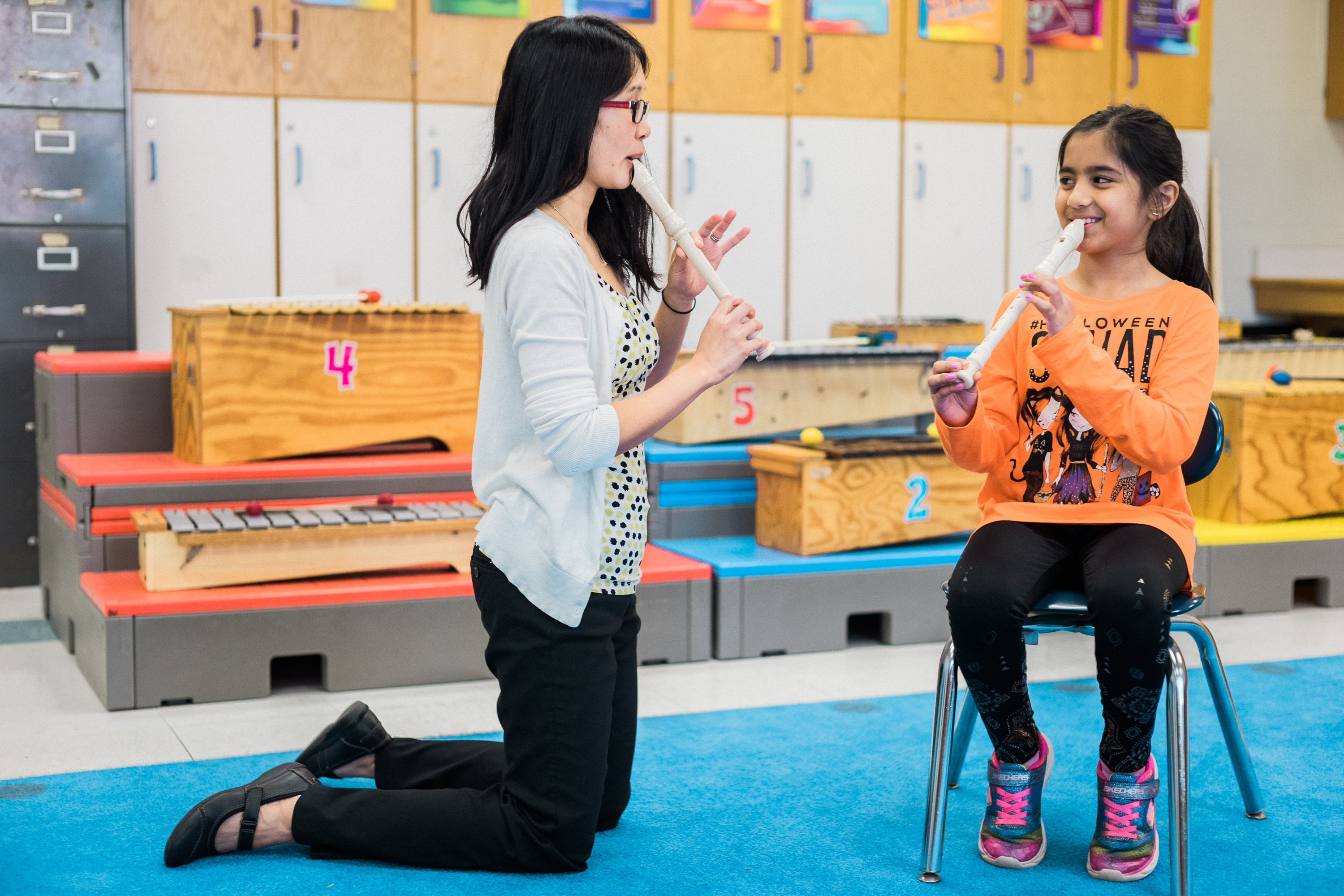
Cerebral Benefits/Facts:
- Everyday listening skills are stronger in musically-trained children than in those without music training. Significantly, listening skills are closely tied to the ability to: perceive oral communication in a noisy background, pay attention, and keep sounds in memory (Strait, D.L. and N. Kraus, Biological bear upon of auditory expertise beyond the life bridge: musicians equally a model of auditory learning. Hearing Research, 2013.)
- Music training in childhood "fundamentally alters the nervous organisation such that neural changes persist in machismo later on auditory training has ceased" (Skoe, Due east. & N. Kraus. 2012. A petty goes a long way: How the Developed Encephalon Is Shaped past Musical Grooming in Childhood. The Journal of Neuroscience, 32(34):11507–11510).
- Studies have shown that young children who accept keyboard lessons have greater abstract reasoning abilities than their peers, and that these abilities improve over time with sustained preparation in music (Rauscher, F.H. , & Zupan, M., "Classroom keyboard instruction improves kindergarten children'due south spatial-temporal performance: A field experiment" Early Childhood Enquiry Quarterly, xv , 215-228.2000).
- Children with learning disabilities or dyslexia who tend to lose focus with more than noise could benefit profoundly from music lessons (Arete Music Academy. "Statistical benefits of music in instruction." Arete Music University. Accessed July 17, 2014).
- Young children who take music lessons show different brain evolution and improved memory over the course of a year, compared to children who do not receive musical preparation (National Association for Music Didactics. "The Benefits of the Report of Music." National Association for Music Educational activity. Accessed July 17, 2014).
- Young Children who take music lessons testify different brain development andimproved memory over the grade of a year, compared to children who practise not receive musical training ( Dr. Laurel Trainor, Prof. of Psychology, Neuroscience, and Behavior at McMaster University, 2006).
- Musically trained children performed better in a retentivity test that iscorrelated with full general intelligence skills such every bit literacy, verbal retentivity, visiospatial processing, mathematics, and IQ ( Dr. Laurel Trainor, Prof. of Psychology, Neuroscience, and Behavior at McMaster University, 2006).
- Music education sharpens student attentiveness (Arts Pedagogy Partnership, 2011).
- Music education equips students to be creative (Arts Instruction Partnership, 2011).
- Everyday listening skills are stronger in musically-trained children than in those without music grooming.Significantly, listening skills are closely tied to the ability to: perceive oral communication in a noisy background, pay attention, and keep sounds in retentivity ( Strait, D.L. and Due north. Kraus, Biological impact of auditory expertise across the life span: musicians every bit a model of auditory learning. Hearing Research, 2013.)
- According to research published in a 2014 articlein Parents magazine, learning how to play percussion instruments helps children develop coordination and motor skills, because they crave movement of the hands, arms, and feet (Kwan, A. 2013, "6 Benefits of Music Lessons," Parents).
- Music and math are highly intertwined. Past understanding beat, rhythm, and scales, children are learning how to divide, create fractions, and recognize patterns (Lynn Kleiner, founder of Music Rhapsody in Redondo Embankment, CA).
- Certain instruments, such as percussion, assistance children develop coordination and motor skills; they require move of the easily, arms, and feet (Kristen Regester, Early on Childhood Programme Director at Sherwood Customs Music School at Columbia Higher Chicago. Copyright © 2013 Meredith Corporation).
- In gild to fully reap the cerebral benefits of a music form, kids can't merely sit at that place and let the audio of music launder over them. They have to exist actively engaged in the music and participate in the form (Dr. Nina Kraus, director of Northwestern's Auditory Neuroscience Laboratory).
- Researchers found that later on 2 years, children who not but regularly attended music classes, but too actively participated in the class, showed larger improvements in how the brain processes voice communication and reading scores than their less-involved peers (Nina Kraus, director of Northwestern'due south Auditory Neuroscience Laboratory, quoted in Melissa Locker, "This Is How Music Can Change Your Encephalon," Time, December 16, 2014).
- A study at the Academy of California at Irvine demonstrated that young kids who participated in music instruction showed dramatic enhancements in abstract reasoning skills. In fact, researchers take establish neural firing patterns that propose that music may hold the key to higher brain function ( Rauscher, Shaw, Levine , Ky and Wright, "Music and Spatial Task Functioning: A Causal Human relationship," University of California , Irvine , 1994) .
- Playing a instrument strengthens centre-manus coordination and fine motor skills, and kids who study an musical instrument learn a lot about field of study, dedication and the rewards of difficult work ( http://nisom.com/index.php/instruction/health-benefits).
- Music training not only helps children develop fine motor skills, simply aids emotional and behavioral maturation too, according to a new study, one of the largest to investigate the effects of playing an instrument on brain development (Amy Ellis Nutt, "Music lessons spur emotional and behavioral growth in children, new study says," The Washington Post, January vii, 2015).
- Music training leads to greater gains in auditory and motor function when begun in young babyhood; by adolescence, the plasticity that characterizes babyhood has begun to decline. Nevertheless, our results establish that music training impacts the auditory arrangement even when it is begun in adolescence, suggesting that a modest amount of training begun later on in life can bear upon neural function (Adam T. Tierney, Jennifer Krizman, Nina Kraus, "Music training alters the course of adolescent auditory development," Proceedings of the National Academy of Sciences, 2015).
- A Canadian written report of 48 preschoolers and published in 2011, establish that verbal IQ increased later on only 20 days of music training. In fact, the increase was five times that of a control grouping of preschoolers, who were given visual art lessons, says lead researcher Sylvain Moreno, an banana professor of psychology at the Academy of Toronto. He constitute that music training enhanced the children'south "executive function"—that is, their brains' ability to plan, organize, strategize and solve issues. And he constitute the effect in 90% of the children, an unusually high rate (Joanne Lipman, "A Musical Gear up for American Schools," The Wall Street Journal, October 10, 2014).
- In a 2009 written report in the Periodical of Neuroscience, researchers used an MRI to study the brains of 31 6-year-former children, earlier and after they took lessons on musical musical instrument for 15 months. They found that the music students' brains grew larger in the areas that control fine motor skills and hearing—and that students' abilities in both those areas as well improved. The corpus callosum, which connects the left and right sides of the brain, grew as well (Joanne Lipman, "A Musical Fix for American Schools," The Wall Street Periodical, October x, 2014).
- Exposing children to music during early development helps them larn the sounds and meanings of words. Dancing to music helps children build motor skills while allowing them to practice cocky-expression. For children and adults, music helps strengthen memory skills (© 2015 Programme for Early Parent Support (PEPS), a 501(C)(iii) nonprofit organization).
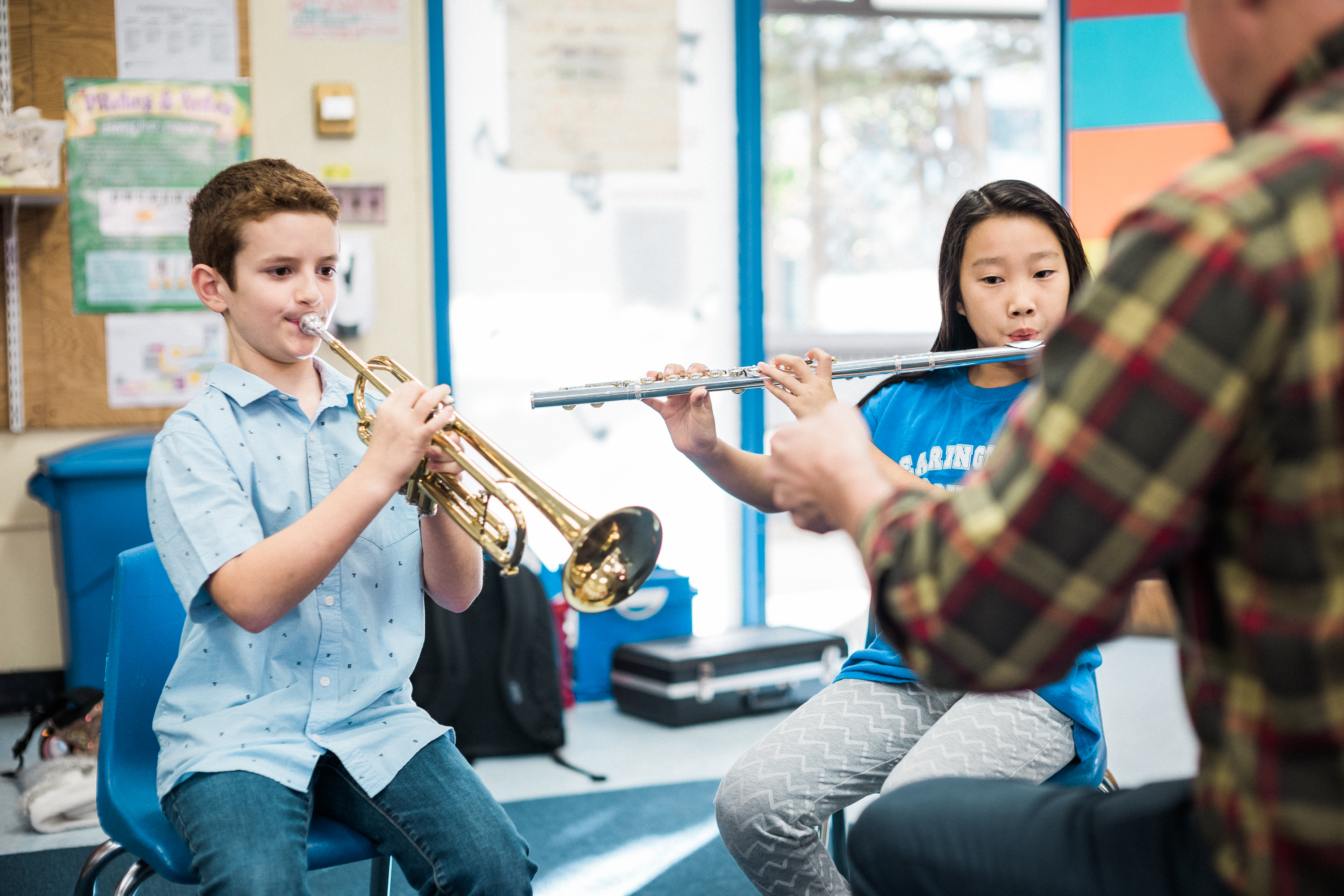
Social Benefits/Facts:
- Children who study a musical instrument are more likely to excel in all of their studies, work better in teams, accept enhanced disquisitional thinking skills, stay in school, and pursue further education (Arte Music Academy. "Statistical benefits of music in teaching." Statistical-Benefits-Of-Music-In-Educational activity. Accessed July 17, 2014).
- Music education supports better study habits and self-esteem (Arts Instruction Partnership, 2011).
- Hispanic and African-American parentsgenerally feel music provides more benefits to children than other parents practice. Similar their urban counterparts, however, they feel they're beingness shortchanged in a number of ways—though they're taking steps to overcome these deficits that could model solutions for other groups ( NAMM Foundation and Grunwald Associates LLC, 2015. Striking a Chord: The Public's Hopes and Behavior for Chiliad–12 Music Education in the United States: 2015).
- Majorities of both parents and teachers meet a myriad of social-emotional, academic, 21st century skill, community, and physical and wellness benefits from music teaching—particularly social-emotional benefits (NAMM Foundation and Grunwald Associates LLC, 2015. Hitting a Chord: The Public's Hopes and Behavior for Thousand–12 Music Instruction in the United States: 2015).
- Majorities of both parents and teachersare enlightened of research on the effects of music on the developing brain, and have personally experienced the benefits of music education on their own children or students (NAMM Foundation and Grunwald Associates LLC, 2015. Striking a Chord: The Public'southward Hopes and Behavior for K–12 Music Education in the United states: 2015).
- Iv of the summit v benefitsteachers see in the potential of music education to help students express themselves (cited by 92 percent of teachers), get more confident (90 percent), and develop better practice habits (89 percent) and more self-subject (88 percent) (NAMM Foundation and Grunwald Associates LLC, 2015. Striking a Chord: The Public'southward Hopes and Beliefs for K–12 Music Pedagogy in the U.s.a.: 2015).
- Majorities of parents whose childrenare involved in music classes also credit music education for making them happier, more focused, more than selfdisciplined, stronger academically and more helpful (NAMM Foundation and Grunwald Associates LLC, 2015. Striking a Chord: The Public'due south Hopes and Beliefs for K–12 Music Education in the United States: 2015).
- Taking music lessons offers a space where kidslearn how to have and requite effective criticism, according to inquiry published in The Wall Street Periodical in 2014 (Joanne Lipman, "A Musical Set for American Schools," The Wall Street Journal, October x, 2014).
- Grouping classes crave peer interaction and communication, which encourage teamwork, as children must collaborate to create a crescendo or an accelerando (Kristen Regester, Early Childhood Program Manager at Sherwood Community Music School at Columbia Higher Chicago. Copyright © 2013 Meredith Corporation).
- Playing an instrument teaches kids to persevere through hours, months, and sometimes years of do before they reach specific goals, such equally performing with a band or memorizing a solo piece (Mary Larew, Suzuki violin instructor at the Neighborhood Music School in New Oasis, Connecticut. Copyright © 2013 Meredith Corporation).
- Lessons offer a forum where children can larn to accept and requite constructive criticism. Turning negative feedback into positive modify helps build self-conviction (Mary Larew, Suzuki violin teacher at the Neighborhood Music School in New Haven, Connecticut. Copyright © 2013 Meredith Corporation).
- Making music together, children learn to piece of work equally a team while they each contribute to the song in their own way. At the same time, music helps children larn that together they can brand something larger than the sum of its parts (© 2015 Plan for Early Parent Back up (PEPS), a 501(C)(3) nonprofit organization).
- More benefits of music for children include learning cooperation, sharing, compromise, inventiveness, and concentration - skills that become invaluable as they enter schoolhouse, confront new challenges, and brainstorm to class new friendships and develop social skills (© 2015 Program for Early Parent Support (PEPS), a 501(C)(three) nonprofit organization).
- Kids who make music have been shown to become along better with classmates and have fewer discipline problems. More than of them become into their preferred colleges, too (http://nisom.com/index.php/instruction/health-benefits).
- 95 percent of Americans consider music to be part of a well-rounded education, and 93 percent experience that schools should offering music pedagogy as office of the regular curriculum. Nearly iv in five (79 per centum) even say that music pedagogy should be mandated for every student in schoolhouse (2003 Gallup Poll conducted for NAMM).
Quotes/Testimonials:
"One of the biggest kicks is to encounter a kid come into the music program as an introvert and get out as a student leader. That's a tremendous process." - Dick Zentner, 2013 Patrick John Hughes Parent/Booster Award Recipient
"We have this holistic opportunity to teach children the benefits of straight participatory music didactics." - Linda Edelstein, Milwaukee youth symphony orchestra
"At this time when you are making critical and far-reaching budget and program decisions…I write to bring to your attending the importance of the arts as a core bookish subject and part of a consummate education for all students. The Elementary and Secondary Educational activity Act defines the arts as a core subject, and the arts play a significant office in children's development and learning process. The arts tin can help students become tenacious, team-oriented trouble solvers who are confident and able to think creatively." - Arne Duncan, Secretary of Educational activity, Letter to Schools and Community Leaders, 2009
"Early sustained music learning is actually the frame upon which didactics itself tin be built for low-income kids." - Margaret Martin, founder, Harmony Project, quoted in PBS NEWS 60 minutes. http://www.pbs.org/newshour/bb/education-january-june14-harmony_01-04
"In science I had very low grades and so once I started learning near music and being able to do and concentrating, my science grades accept gone college and so take my other course in other subjects. I would concentrate in my music and it was something to be focused on and non exist bothered by anyone. I was using that on my homework and on any blazon of class work also. Scientific discipline is at present ane of my all-time subjects." - Vianey Calixto, student and Harmony Project Participant quoted in PBS NEWS HOUR. http://world wide web.pbs.org/newshour/bb/educational activity-january-june14-harmony_01-04
"While more affluent students do better in school than children from lower income backgrounds, we are finding that musical training tin modify the nervous organisation to create a better learner and help showtime this academic gap." - Dr. Nina Kraus, director of Northwestern'south Auditory Neuroscience Laboratory quoted in "Musical training 'can improve language and reading" http://www.bbc.com/news/health-28703013
"Music is no cure-all, nor is it probable to turn your child into a Nobel Prize winner. Merely at that place is compelling evidence that it can heave children'due south academic performance and help fix some of our schools' near intractable bug." - Joanne Lipman, "A Musical Ready for American Schools," The Wall Street Periodical, Oct 10, 2014
"A kid with a music degree isn't express to a functioning or educational activity career. Musicians are everywhere. Nosotros are project managers, marketers, Finance folks, It people and engineers. In my twenty-some years as a corporate Hour person, I was always impressed by the way musical people excelled at logic and not-linear thinking, both." - Liz Ryan, "Let the kids study music, already!" Forbes, September 3, 2014
"Being able to recall on your feet, approach tasks from different perspectives and think 'outside of the box' will distinguish your child from others. In an arts plan, your kid will be asked to recite a monologue in 6 dissimilar ways, create a painting that represents a retentivity, or compose a new rhythm to enhance a piece of music. If children have practice thinking creatively, it will come naturally to them now and in their future career." - Lisa Phillips, "The creative edge: 7 skills children need to succeed in an increasingly right encephalon world," ARTSblog, Americans for the Arts, 2013
"When a child picks up a violin for the first time, she/he knows that playing Bach right abroad is not an selection; however, when that child practices, learns the skills and techniques and doesn't requite up, that Bach concerto is that much closer. In an increasingly competitive world, where people are being asked to continually develop new skills, perseverance is essential to achieving success." - Lisa Phillips, "The artistic edge: 7 skills children need to succeed in an increasingly correct brain world," ARTSblog, Americans for the Arts, 2013
"The ability to focus is a cardinal skill developed through ensemble work. Keeping a residue between listening and contributing involves a neat deal of concentration and focus. It requires each participant to not merely think nearly their role, only how their role contributes to the large motion picture of what is beingness created. Recent enquiry has shown that participation in the arts improves children'due south abilities to concentrate and focus in other aspects of their lives." - Lisa Phillips, "The creative edge: 7 skills children demand to succeed in an increasingly right brain world," ARTSblog, Americans for the Arts, 2013
"When a child has a part to play in a music ensemble, or a theater or trip the light fantastic production, they begin to sympathize that their contribution is necessary for the success of the group. Through these experiences children gain confidence and outset to larn that their contributions have value even if they don't have the biggest role." - Lisa Phillips, "The artistic border: vii skills children need to succeed in an increasingly correct brain earth," ARTSblog, Americans for the Arts, 2013
"I believe arts education in music, theater, trip the light fantastic, and the visual arts is one of the virtually creative ways we accept to find the gold that is buried but beneath the surface. They (children) have an enthusiasm for life a spark of creativity, and vivid imaginations that demand training – grooming that prepares them to go confident young men and women." - Richard W. Riley, Erstwhile U.s.a. Secretarial assistant of Education
"Music education opens doors that help children pass from school into the world around them – a globe of work, culture, intellectual activity, and human involvement. The time to come of our nation depends on providing our children with a complete education that includes music." - Gerald Ford, One-time President of the The states
"Music is about communication, creativity, and cooperation, and by studying music in schools, students have the opportunity to build on these skills, enrich their lives, and experience the world from a new perspective." - Bill Clinton, Sometime President of the United states of america
"A broad education in the arts helps give children a better understanding of their globe… We need students who are culturally literate likewise as math and scientific discipline literate." - Paul Ostergard, Vice President, Citicorp
"Arts didactics aids students in skills needed in the workplace: flexibility, the ability to solve issues and communicate, the ability to learn new skills, to exist creative and innovative, and to strive for excellence." - Joseph M. Calahan, Director of Cooperate Communications, Xerox Corporation
"The hope of our music, the entire future of our music, unquestionably lies in our children." - Aubertine Woodward Moore, "Our Children, The Promise of Music: Building a Musical America," The Art World, Vol. 2, No. 6, pp. 512-514, September 1917
"Research indicates the encephalon of a musician, even a immature one, works differently than that of a nonmusician. "There's some skillful neuroscience research that children involved in music have larger growth of neural activity than people not in music training. When you're a musician and you're playing an instrument, you take to be using more of your brain." - Dr. Eric Rasmussen, chair of the Early Childhood Music Department at the Peabody Preparatory of The John Hopkins University, quoted in "The Benefits of Music Education," pbs.org, Laura Lewis Dark-brown
"I would teach children music, physics, and philosophy; but most importantly music, for the patterns in music and all the arts are the keys to learning." - Plato
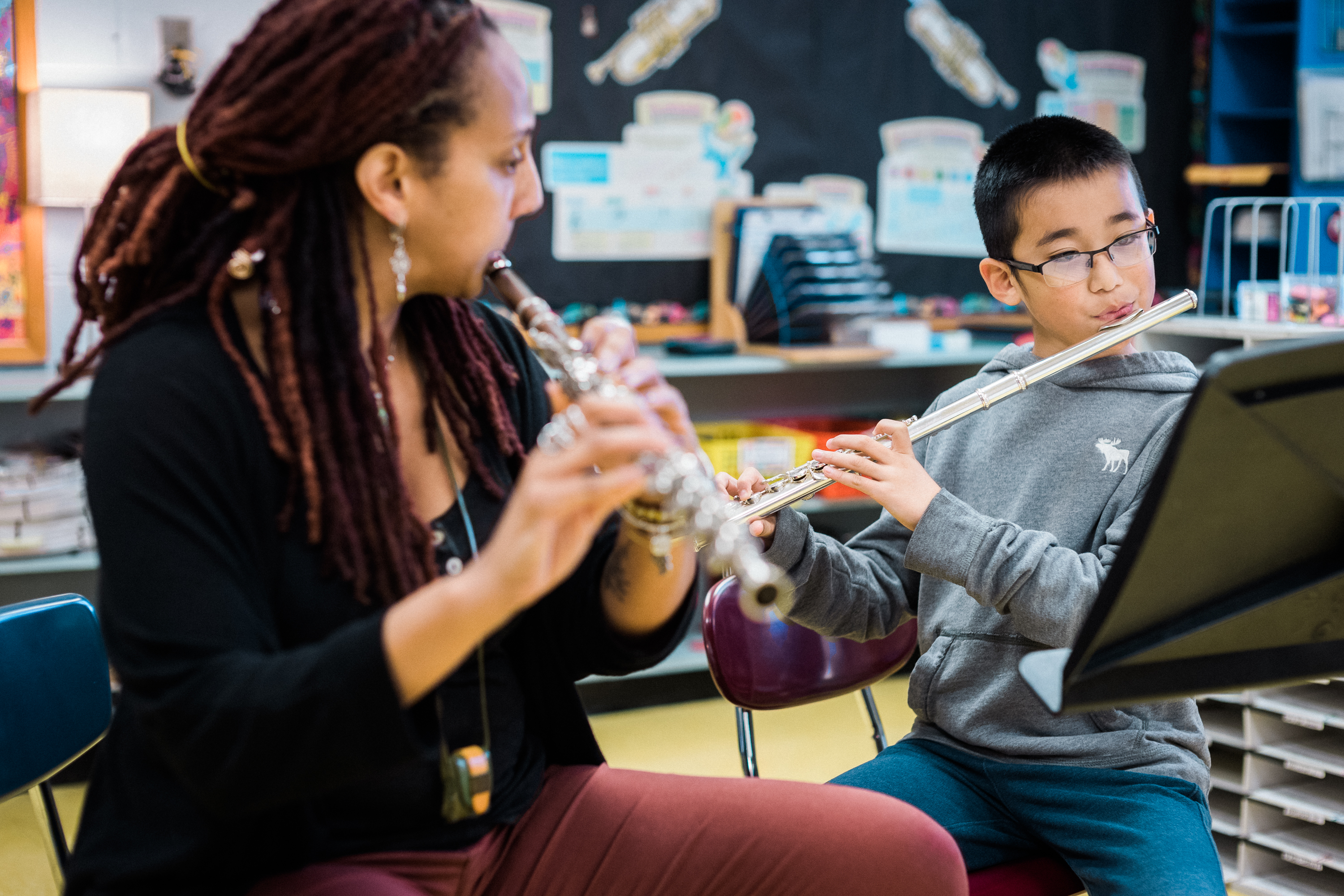
More Benefits/Facts:
- Enquiry tells united states children who play music exercise ameliorate in school and in life.
- A recent Gallup Poll revealed that 94 percent of Americans consider music to exist part of a well-rounded education. (Source: NAMM Gallup poll 2006.)
- A Columbia University study revealed that students in the arts are found to be more than cooperative with teachers and peers, more cocky-confident and improve able to express their ideas. (Source: Burton, J., Horowitz, R., Abeles, H. Champions of Alter, Arts Education Partnership, 1999.)
- Students indicate that arts participation motivates them to stay in schoolhouse, and that the arts create a supportive surround that promotes constructive credence of criticism and one in which it is safe to have risks. (Source: Barry, N., Taylor, Chiliad. and Yard. Walls Critical Links: Learning in the Arts and Student Academic and Social Development, AEP, 2002.)
- A study examined the influence of music education on nonmusical abilities, the effects of music lessons on academic functioning, and cognitive abilities. The study revealed that students who participated in music lessons showed statistically college intelligence quotients. (Source: Glenn Schellenberg, Music Lessons Heighten IQ, Psychological Science, Vol. 15, No. eight, 2004.)
- A written report of rural and urban inner-city schools found that arts programs helped schools in economically disadvantaged communities develop students' disquisitional-thinking and trouble solving skills. (Source: Stevenson, 50., Deasy, R., Third Space: When Learning Matters, AEP, 2005.)
- With music in schools, students connect to each other meliorate— greater camaraderie, fewer fights, less racism and reduced use of hurtful sarcasm. (Source: Jensen, E., Arts With the Brain In Mind, Association for Supervision and Curriculum Development, 2001.)
- The vast majority —96 percent—of the school principals interviewed in a recent study agree that participation in music didactics encourages and motivates students to stay in school. Further, 89 percent of principals experience that a high-quality music educational activity program contributes to their school achieving higher graduation rates. (Source: Harris Interactive Poll, 2006.)
- The skills gained through sequential music educational activity, including discipline and the ability to clarify, solve problems, communicate and work cooperatively, are vital for success in the 21st century workplace. (Source: U.S. House of Representatives, Concurrent Resolution 355, March half-dozen, 2006.)
Photograph credit: Rob Davidson Photography
chadwickanythincel.blogspot.com
Source: https://www.nammfoundation.org/articles/2014-06-09/how-children-benefit-music-education-schools%20
0 Response to "Data Suggesting That Reduced School Funding Negatively Music and Arts in Schools"
Postar um comentário